


Four Fellows are working on projects to understand the lifecycle and spread of alpha-synuclein, a hallmark protein aggregate in Parkinson’s disease, including specific mechanisms of pathology initiation, aggregate transmission, and selective vulnerability in subtypes of dopaminergic neurons. These researchers will decode the initial molecular events of Parkinson’s and move to early-stage intervention, ultimately building the foundation for the next generation of disease-modifying therapies.
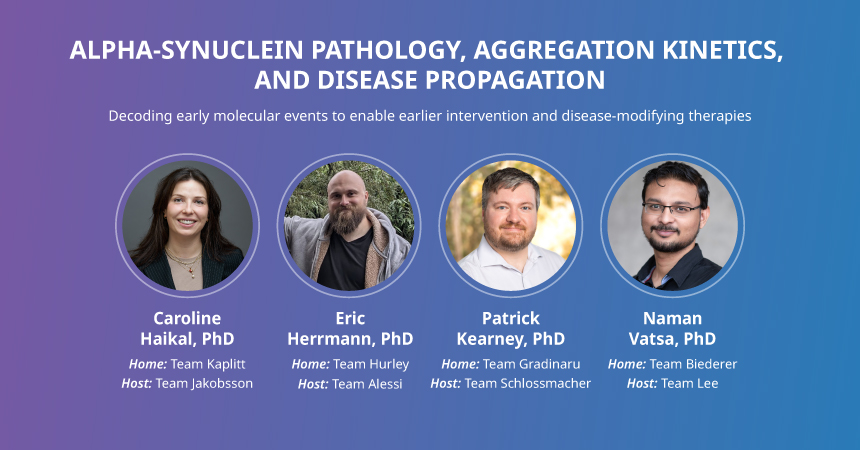
Caroline Haikal, PhD
Project Title: Using host-to-graft models to investigate alpha-synuclein transsynaptic propagation
Home Team: Kaplitt (Kaplitt Lab)
Host Team: Jakobsson (Barker Lab)
Institution: Weill Cornell Medicine
Project Summary: Recent work with alpha-synuclein preformed fibrils (PFFs) in mouse models has called into question whether alpha-synuclein propagates transsynaptically or progressively accumulates due to non-neuronal factors. This project will use grafted neurons to examine alpha-synuclein transsynaptic propagation. Approaches include transplanting neurons into the striatum or hypoglossal nucleus of striatum-PFF-injected or transgenic mice to elucidate whether direct neuronal connectivity is needed for asyn host-to-graft transmission, and grafting asyn-overexpressing neurons into wild-type mouse brains to determine whether non-neuronal cells are required for alpha-synuclein transmission.
Eric Herrmann, PhD
Project Title: Cryo-ET and lipidomics of lysosome damage in familial and sporadic Parkinson’s disease
Home Team: Hurley (Hurley Lab)
Host Team: Alessi (Abu-Remaileh Lab)
Institution: University of California, Berkeley
Project Summary: Aggregation of alpha-synuclein is a hallmark of familial and sporadic Parkinson’s disease. Parkinson’s disease genetics strongly implicates lysosomal dysfunction in disease progression. This project integrates cryo-ET and lipidomics to explore how alpha-synuclein aggregation and lysosome dysfunction engage in a negative feedback loop to exacerbate disease. Cryo-ET will be used to visualize α-synuclein-induced lysosome damage and repair in neurons at molecular resolution, and lipidomics will measure changes in lysosomal lipids that are invisible to cryo-ET. The project will culminate by assessing whether strategies to boost lysosome biogenesis and resilience can rescue the Parkinson’s disease-associated defects.
Patrick Kearney, PhD
Project Title: Mechanisms underlying global spread of pathologic alpha-synuclein after single nasal injury
Home Team: Gradinaru (Roy Lab)
Host Team: Schlossmacher (Arenkeil Lab)
Institution: University of California, San Diego
Project Summary: Phosphorylation of alpha-synuclein at Ser129 (a-syn pSer129) is a pathologic hallmark of Parkinson’s disease, with high levels of physiologic pSer129 within the olfactory system. Early olfactory dysfunction is an established feature of Parkinson’s disease, suggesting pSer129-induced vulnerability in this circuitry. Previous research from this team found that a single (reversible) nasal injury triggered a sustained increase in pSer129 throughout the brain, persisting even after the expected resolution of the local insult. This project will expand on those findings to explore mechanisms underlying pSer129 spread from olfactory bulb to brain after nasal injury and evaluate Parkinson’s disease-relevant consequences that may offer insights into the initiation and spread of the disease.
Naman Vatsa, PhD
Project Title: Determining mechanisms of alpha-synuclein inclusion formation regulated by Group II PAK kinases
Home Team: Biederer (Henderson Lab)
Host Team: Lee (Moore Lab)
Institution: Van Andel Research Institute
Project Summary: The accumulation of alpha-synuclein aggregates is a defining pathological hallmark of Parkinson’s disease, yet the cellular mechanisms that govern their initiation, growth, and clearance remain poorly understood. Preliminary data identify group II p21-activated kinases (PAK5 and PAK6) as novel regulators of alpha-synuclein pathology. This project will define how group II PAK inhibition protects against alpha-synuclein pathology by imaging aggregate formation and clearance and by dissecting the downstream signaling pathways involved. Together, these studies will establish the causal role of PAK5/6 in alpha-synuclein inclusion biology and reveal molecular mechanisms of Parkinson’s disease pathogenesis, providing a foundation for therapeutic targeting.
Four Fellows are working on projects to investigate the breakdown and repair of intracellular maintenance systems, seeking to describe molecular pathways underlying mitochondrial homeostasis, lysosomal remodeling, endolysosomal trafficking, and ciliary signaling. Alterations in these pathways may serve as potential biomarkers of Parkinson’s disease. These researchers will determine where cellular quality control fails and how to rescue it, ultimately halting disease progression.

Odetta Antico, PhD
Project Title: Untangling PINK1–Tau crosstalk and co-morbidity mechanisms in Parkinson’s disease
Home Team: Alessi (Muqit Lab)
Host Team: Harper (Harper Lab)
Institution: University of Dundee
Project Summary: Emerging evidence links Tau-driven mitochondrial dysfunction to Parkinson’s disease. This project tests the hypothesis PTEN-induced kinase 1 (PINK1) and Tau interact in a feed-forward loop in which PINK1 deficiency drives pathogenic Tau changes, while Tau impairs PINK1-dependent mitochondrial homeostasis. Building on preliminary evidence connecting PINK1 loss to human Tau phosphorylation at phosphoSer214 (pSer214) and leveraging relevant mouse models, including a novel phosphomimetic PINK1-TESE knock-in mouse, this project aims to define the Tau post-translational modification code and interactome under PINK1 deficiency, quantify in vivo mitophagy thresholds and regional flux, and map pS65-Ubiquitin and pSer214-Tau dynamics as early biomarkers. Integrated proteomics, biochemistry, and imaging will reveal mechanistic nodes and test PINK1 enhancement as a disease-modifying strategy.
Bishal Basak, PhD
Project Title: Targeting Rubicon to restore lysosomal and autophagic health in LRRK2-driven Parkinson’s disease
Home Team: Hurley (Holzbaur Lab)
Host Team: Alessi (Alessi & Muqit Labs)
Institution: University of Pennsylvania
Project Summary: Hyperactive mutations in leucine-rich repeat kinase 2 (LRRK2), the most common genetic cause of Parkinson’s disease, impair lysosomal acidification and autophagic turnover, leading to neuronal vulnerability. Rubicon, a neuron-enriched protein, has recently been identified as a key negative regulator of lysosomal and autophagic function, particularly in neurons. This project will define the mechanistic role of Rubicon in lysosomal remodeling and autophagy, and determine whether its inhibition can restore degradative defects caused by LRRK2 hyperactivity. Broadly, this study will establish Rubicon as a critical node in neuronal quality control and highlight its potential as a target for restoring degradative capacity and resilience in Parkinson’s disease.
Amanda Bentley-DeSousa, PhD
Project Title: The Parkinson’s disease kinase LRRK2 regulates lysosome damage
Home Team: De Camilli (Ferguson Lab)
Host Team: Harper (Harper Lab)
Institution: Yale University School of Medicine
Project Summary: Lysosome damage is a critical hallmark of Parkinson’s disease, with many Parkinson’s disease-relevant proteins playing a role. Environmental, genetic, and cellular stressors cause the lysosomal activation of LRRK2, with hyperactivation enhancing Parkinson’s disease risk. Previous work identified a key signaling pathway involving the conjugation of ATG8 to single membranes and gamma-aminobutyric acid receptor-associated protein as a critical means of activating LRRK2, linking diverse stress inputs to disease pathways. Preliminary data show that this increased LRRK2 activity enhances lysosomal damage and TANK-binding kinase 1 (TBK1)–Rab7 signaling. This project integrates expertise in cell biology and proteomics to define novel LRRK2 substrates and uncover the link between LRRK2 and TBK1–Rab7 signaling, in an effort to elaborate on therapeutic strategies in Parkinson’s disease.
Prosenjit Pal, PhD
Project Title: Decoding the role of endolysosomal and ciliary crosstalk in Parkinson’s disease pathogenesis
Home Team: Alessi (Alessi Lab)
Host Team: De Camilli (Ferguson Lab)
Institution: University of Dundee
Project Summary: Emerging evidence links defects in endolysosomal trafficking and aberrant ciliogenesis to Parkinson’s disease, though their crosstalk is unclear. One hypothesis is that hyperactive Parkinson’s disease-causing proteins, such as LRRK2 and vacuolar protein sorting 35 (VPS35), impair this interaction, disrupting ciliary signalling essential for dopaminergic neuron survival. Using mutant mouse models, mouse embryonic fibroblasts, human iPSC-derived neurons, and advanced tools—including proteomics, lipidomics, live-cell lipid biosensors, and super-resolution microscopy—this project will dissect how these pathways drive neurodegeneration, aiming to uncover mechanisms, identify biomarkers, and highlight novel therapeutic targets that could halt Parkinson’s disease progression.
Six Fellows are investigating how synaptic signaling, axonal architecture, neuromodulation, and bioenergetic stress converge to drive selective vulnerability within dopaminergic circuits in Parkinson’s disease. Their work incorporates human-derived models of dopaminergic neuron subtypes, mechanisms of neurotransmitter release and modulation in basal ganglia circuits, and the impact of metabolic dysfunction on synaptic and circuit-level dopamine dynamics. By linking metabolic demands and molecular pathology to circuit function and behavior, these researchers seek to explain why specific dopaminergic neuron populations are affected by Parkinson’s disease neurodegeneration while other populations remain resilient, and to identify strategies to restore dopamine signaling and motor function.
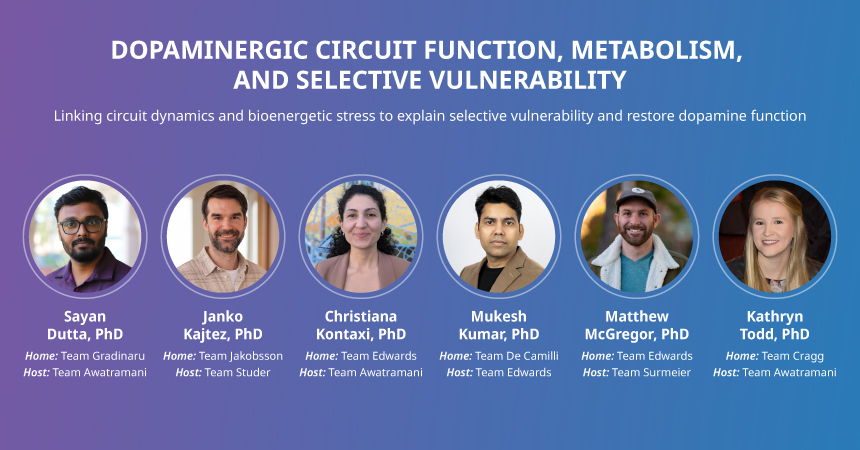
Sayan Dutta, PhD
Project Title: Dissecting the effects of alpha-synuclein pathology on the selective vulnerability of midbrain dopaminergic neuronal subtypes utilizing spatial single-cell proteomics
Home Team: Gradinaru (Gradinaru Lab)
Host Team: Awatramani (Awatramani Lab)
Institution: California Institute of Technology
Project Summary: Loss of midbrain dopaminergic neurons (mDANs) underlies motor dysfunction in Parkinson’s disease. In patients, neurons in the ventral substantia nigra pars compacta are particularly vulnerable, whereas dorsal neurons are resistant. Basal transcriptomic differences cannot fully explain this selective cell-type vulnerability. This project will explore whether an additional disease-causing factor, such as alpha-synuclein aggregation, is needed for mDANs to exhibit a Parkinson’s disease-like vulnerability trend. This project will test whether alpha-synuclein pathology preferentially induces degeneration of Anxa1⁺ ventral mDANs using AAV-mediated aSyn overexpression in mice. In addition, spatial single-cell proteomics in mouse and Parkinson’s disease patient tissue will be used to define subtype-specific molecular pathways and protein targets mediating vulnerability or resilience.
Janko Kajtez, PhD
Project Title: Recapitulating subtype-specific cell-autonomous human dopaminergic vulnerability in Parkinson’s disease
Home Team: Jakobsson (Kirkeby Lab)
Host Team: Studer (Studer Lab)
Institution: University of Copenhagen
Project Summary: The selective vulnerability of A9 dopaminergic neurons in Parkinson’s disease may arise from their extraordinary bioenergetic demands, driven by large axonal arbors and pacemaking activity. To test this hypothesis in a human context, this project integrates stem cell technology and bioengineering to control axonal length and activity, model Parkinson’s disease-penetrance factors, and assess axonal transport deficits. By combining structural, functional, and molecular analyses, this work aims to define how arbor size and metabolic load intersect with these stressors to trigger A9 degeneration. These insights will provide a foundation for innovative strategies to model and treat Parkinson’s disease.
Christiana Kontaxi, PhD
Project Title: LRRK2 and neurotransmitter release
Home Team: Edwards (Edwards Lab)
Host Team: Awatramani (Bevan Lab)
Institution: University of California, San Francisco
Project Summary: Mutations in the leucine-rich repeat kinase 2 (LRRK2) are a common cause of Parkinson’s disease, but the mechanism remains unknown. Although most research on pathogenesis focuses on dopamine neurons that degenerate in Parkinson’s disease, LRRK2 is highly expressed in spiny projection neurons in the striatum, suggesting the mutations affect basal ganglia circuitry. Previous work recently identified a specific effect of the G2019S LRRK2 Parkinson’s disease mutation on GABA release by striatal neurons. This project will investigate the role of this defect in basal ganglia circuitry and the mechanism by which G2019S LRRK2 impairs release.
Mukesh Kumar, PhD
Project Title: Does pathogenic α-synuclein disrupt lipid droplet–mitochondria coupling in Parkinson’s disease?
Home Team: De Camilli (Ryan Lab)
Host Team: Edwards (Edwards Lab)
Institution: Weill Cornell Medicine
Project Summary: Emerging evidence highlights bioenergetic failure as a central driver of Parkinson’s disease pathology, accompanied by abnormal triglyceride (TG) accumulation in neuronal lipid droplets (LD) in Parkinson’s disease brain. Previous work recently overturned the dogma that the brain and neurons do not carry out beta-oxidation, underpinned by the discovery of mutations in a neuron-specific TG lipase. Notably, alpha-synuclein fibrils readily associate with LDs, suggesting a link between synucleinopathy, TG metabolism, and bioenergetics. This project tests the hypothesis that alpha-synuclein-LD interaction alters TG turnover, thereby compromising beta-oxidation and ATP production to drive synaptic dysfunction. This metabolic bottleneck may contribute to progressive neurodegeneration in Parkinson’s.
Matthew McGregor, PhD
Project Title: How the spatiotemporal dynamics of dopamine transmission shift in Parkinson’s disease to support motor function
Home Team: Edwards (Ford Lab)
Host Team: Surmeier (Ding Lab)
Institution: University of Colorado Anschutz Medical Campus
Project Summary: Limited understanding of dopamine spatial dynamics is a major constraint on treating Parkinson’s disease. While broad regional dynamics have been extensively characterized, how local dynamics are encoded in striatal circuits and how they are altered in Parkinson’s disease remain unclear. This project aims to determine how alpha-synuclein accumulation and progressive dopamine neuron degeneration impact local dopamine dynamics to drive the motor symptoms of Parkinson’s disease. Using 2-photon imaging to map local dopamine dynamics in two Parkinson’s disease models, this work will determine how changes in these dynamics induce impaired behavior. Together, these studies will establish a new paradigm for exploring dopamine dynamics in Parkinson’s disease.
Kathryn Todd, PhD
Project Title: Parsing the diverse neuromodulation of vulnerable versus resistant dopamine axons according to distinct molecular subtype
Home Team: Cragg (Cragg Lab)
Host Team: Awatramani (Dombeck Lab)
Institution: University of Oxford
Project Summary: Dopamine axon function, and therefore striatal output and behavior, is profoundly and diversely shaped by striatal neuromodulators. Crucially, a previously underappreciated heterogeneity of dopamine neurons exists whereby molecularly-distinct dopamine neuron subtypes exhibit differential vulnerability to degeneration in Parkinson’s disease. However, how distinct neuromodulators govern dopamine axon function of these distinct subtypes is not known. This project will fill this knowledge gap using a multi-disciplinary approach and state-of-the-art tools. By characterizing distinct modulatory mechanisms of vulnerable versus resistant dopamine axons, this work can inform the development of targeted and improved strategies to rescue dopamine dysfunction in Parkinson’s disease.
Five Fellows have projects exploring the role of the immune system, environmental factors, and non-neuronal cells in Parkinson’s disease pathogenesis. Specific topics examine interactions between Parkinson’s disease-linked genetic vulnerability and the immune response, how alpha-synuclein pathology affects immune response, and the influence of inflammation on dopaminergic activity. By studying how the microbiome, genetics, and overlooked cell types trigger inflammation and drive cell death, these researchers forge a path for immune-targeted therapies and new approaches in precision medicine.

M. Elizabeth Deerhake, MD, PhD
Project Title: Identifying common, non-coding genetic drivers of neuroinflammation in Parkinson’s disease
Home Team: Hafler (Hafler Lab)
Host Team: Scherzer (Scherzer Lab)
Institution: Yale University
Project Summary: This project aims to uncover the role of neuroinflammation in Parkinson’s disease by identifying non-coding genetic variants regulating gene expression in innate immune cells. A massively parallel report assay (MPRA) will screen thousands of Parkinson’s disease-associated variants for regulatory activity in macrophages. Next, the Scherzer lab’s Parkinson5D Atlas will be used to identify variants with in vivo allele-specific regulatory effects in brain macrophages, microglia, and monocytes. Integrating experimental and computational findings, this project will map the expression of target genes across brain regions and disease stages. This work will advance Parkinson’s disease research by prioritizing genetically supported neuroimmune pathways.
James Evans, PhD
Project Title: Oligodendrocyte-driven innate and adaptive inflammation in Parkinson’s disease
Home Team: Wood (Gandhi Lab)
Host Team: Studer (Khurana Lab)
Institution: University College London
Project Summary: Parkinson’s disease is defined by dopaminergic neuronal loss and alpha-synuclein aggregates in Lewy bodies. However, evidence from genetics and single-cell transcriptomics indicates a substantial oligodendroglial component, and data suggest alpha-synuclein oligomers drive a pro-inflammatory oligodendrocyte state. Yet, mechanisms by which oligodendrocyte-specific inflammation propagates to immune cells and impacts neuronal health remain unknown. This project will employ iPSC-derived oligodendrocyte and co-culture paradigms, alongside patient T cells, to investigate how alpha-synuclein-induced oligodendrocytes influence glia, neurons, and T cells. Investigating oligodendrocyte-mediated crosstalk and disease-specific T cell responses enables the definition of blood-based immune signatures relevant for patient stratification in Parkinson’s disease.
Amandine Even, PhD
Project Title: Exploring the role of glia and T cells in the fatal outcome of vulnerable neurons in Parkinson’s disease
Home Team: Desjardins (Trudeau Lab)
Host Team: Schapira (Deleidi Lab)
Institution: University of Montreal
Project Summary: Inflammation is a hallmark of Parkinson’s disease and may exacerbate intrinsic neuronal vulnerability. This project will test whether systemic inflammation modulates dopaminergic and noradrenergic neuronal activity using in vivo fiber photometry and patient-derived iPSC cocultures. Furthermore, innovative quadripartite iPSC cocultures (neurons, astrocytes, microglia, and T cells) will be used to examine how these cell types interact to drive selective neuronal vulnerability. Finally, a brain-chip model will examine how patient-derived glia influence T cell infiltration. This integrated approach, distinguishing early functional alterations from degeneration, will clarify mechanisms linking inflammation to neuronal loss and reveal potential novel therapeutic targets in Parkinson’s disease.
Alexandra Kazanova, PhD
Project Title: Unravelling the impact of the microbiome on motor dysfunction in Parkinson’s disease using phenotypic heterogeneity in the Pink1-/- infection-induced disease model
Home Team: Desjardins (Gruenheid Lab)
Host Team: Sulzer (Mazmanian Lab)
Institution: McGill University
Project Summary: Development of Parkinson’s disease involves genetic and environmental factors. The microbiome and intestinal inflammation have both been implicated as environmental triggers in genetically susceptible individuals. Previous work has shown that gastrointestinal infection of mice with genetic Parkinson’s disease susceptibility (Pink1-/-) causes dopamine-sensitive motor impairments. However, about 30% of these mice, despite a similar course of infection, do not develop motor phenotypes, suggesting a role for additional factors in disease progression. Recent work found that the development of disease in this model depends on gut microbiome composition. This project will leverage this novel system to characterize how the microbiome interacts with genetic Parkinson’s disease susceptibility to trigger disease.
Indrani Poddar, PhD
Project Title: The pathogenic role of neuronal DNA-sensing cGAS–STING pathway in alpha-synucleinopathy
Home Team: Lee (Lee Lab)
Host Team: Studer (Khurana Lab)
Institution: University of Minnesota
Project Summary: Parkinson’s disease and other alpha-synucleinopathies are characterized by neuronal aggregation of alpha-synuclein. Previous work has shown that neurons with alpha-synuclein aggregates show activation of the DNA-sensing cyclic GMP-AMP synthase (cGAS)-stimulator of interferon genes (STING) cascade, including the substantia nigra dopaminergic neurons. Although the cGAS-STING pathway has been implicated in Parkinson’s disease, it is thought that the activation occurs in glial cells. Thus, the significance of neuronal cGAS-STING activation remains unexplored. The main goal of this proposal is to define how alpha-synuclein pathology leads to DNA damage and the cGAS-STING response in different types of human neurons, leading to inflammation and neurodegeneration.
Four Fellows are examining how gene regulatory mechanisms shape neuronal vulnerability and resilience in Parkinson’s disease. Their projects investigate how disease-linked mutations, aging-associated regulatory processes, and noncoding genomic elements alter neuronal states through disrupted RNA splicing, enhancer activity, and epigenomic regulation, including transposable elements. By integrating single-cell and multi-omic profiling with computational modeling and targeted perturbations, these projects aim to define causal regulatory pathways that drive degeneration or promote resilience, generating predictive frameworks and biomarker-relevant insights to support precision therapeutic strategies.

Jonathan Brenton, PhD
Project Title: Dissecting splicing dysregulation caused by LRRK2 mutations through multi-omics profiling
Home Team: Hardy (Hardy Lab)
Host Team: Alessi (Alessi Lab)
Institution: University College London
Project Summary: Recent work has identified widespread splicing dysregulation in LRRK2 p.G2019S brain tissues and models. Building upon these novel findings, this project will generate an integrated map of splicing and proteomic changes in brain tissue from three disease-causing LRRK2 mutations to comprehensively dissect LRRK2 Parkinson’s disease mis-splicing. The most dysregulated targets identified will be screened in publicly available datasets for their biomarker potential. Candidate transcripts will also be inserted into neuronal cell lines to understand their impact on cellular function, providing new diagnostic and therapeutic strategies for Parkinson’s disease.
J. Kate Brynildsen, PhD
Project Title: Network control of neuronal resilience in Parkinson’s disease
Home Team: Biederer (Bassett Lab)
Host Team: Gradinaru (Gradinaru Lab)
Institution: University of Pennsylvania
Project Summary: This project investigates mechanisms of neuronal resilience in Parkinson’s disease by integrating computational modeling with experimental validation. Using a duplex network control theory framework, neurons will be modeled across two layers: cell type identity and activity-dependent transcription. Simulations will predict how stimulation of defined inputs influences resilience-associated gene expression. Predictions will be validated with optogenetics, single-cell transcriptomics, and AAV-based perturbations in Parkinson’s-relevant circuits. This research will develop a computational framework linking input-specific activity to gene expression and will experimentally test and refine predictions in substantia nigra neurons. This integrative approach seeks to identify resilience-conferring genes and pathways in Parkinson’s disease.
Raquel Garza Gomez, PhD
Project Title: Dynamic regulatory role of Transposable Elements through human aging and Parkinson’s disease
Home Team: Jakobsson (Jakobsson Lab)
Host Team: Voet (Voet Lab)
Institution: Lund University
Project Summary: Aging is the primary risk factor for Parkinson’s disease, featuring epigenetic alterations that correlate with chronological age. Notably, Parkinson’s disease patients exhibit accelerated epigenetic aging. Previous work has identified Transposable Elements (TEs) as dynamic brain regulatory sequences responsive to epigenetic changes and linked to Parkinson’s disease. This project will profile aging- and Parkinson’s disease-associated epigenetic changes in TEs at single-cell and spatial resolution. By integrating existing long-read DNA, short-read single-cell multi-omic data, novel long-read single-cell epigenome-plus-transcriptome sequencing, and TE-centric bioinformatics, this project has the potential to redefine aging and Parkinson’s disease paradigms while developing multi-omics tools and analytical frameworks.
Weiqiang Liu, PhD
Project Title: Causal mapping of enhancer-gene networks in Parkinson’s disease via single-cell perturb-seq and AI
Home Team: Scherzer (Dong Lab)
Host Team: Rio (Soldner Lab)
Institution: Yale University School of Medicine
Project Summary: Enhancers are critical regulators of gene expression, yet their functions remain poorly understood in Parkinson’s disease. Leveraging the Parkinson5D multi-omics dataset, this project will prioritize ~1,000 high-confidence Parkinson’s disease-relevant enhancers and silence them in iPSC-derived neurons and glia using CRISPRi, followed by single-cell RNA sequencing. These perturbational data will train an AI model to simulate enhancer activity and predict their downstream effects in Parkinson’s disease patient cohorts. This integrative approach will map causal enhancer-gene relationships, reconstruct Parkinson’s disease-specific regulatory networks, and generate openly available datasets and predictive tools, providing mechanistic insights that may guide therapeutic discovery in neurodegeneration.
