


Alpha-Synuclein Pathology, Aggregation Kinetics, and Disease Propagation
Four Fellows are working on projects to understand the lifecycle and spread of alpha-synuclein, a hallmark protein aggregate in Parkinson’s disease, including specific mechanisms of pathology initiation, aggregate transmission, and selective vulnerability in subtypes of dopaminergic neurons. These researchers will decode the initial molecular events of Parkinson’s and move to early-stage intervention, ultimately building the foundation for the next generation of disease-modifying therapies.
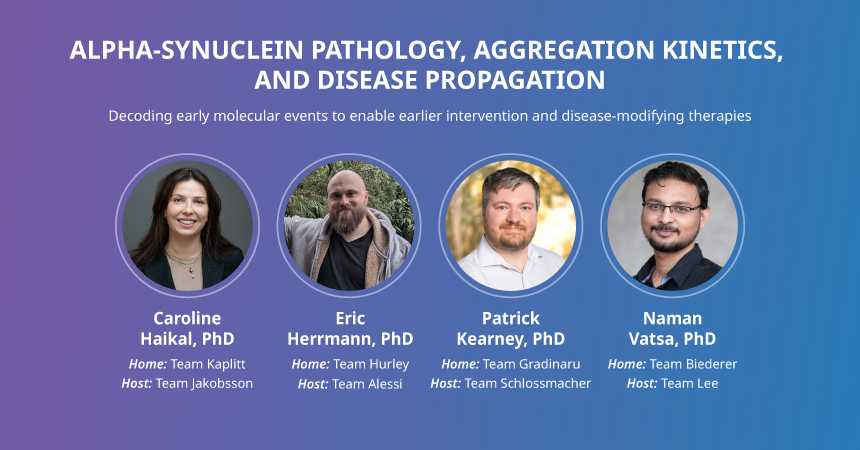
Caroline Haikal, PhD
Project Title: Using host-to-graft models to investigate alpha-synuclein transsynaptic propagation
Home Team: Kaplitt (Kaplitt Lab)
Host Team: Jakobsson (Barker Lab)
Institution: Weill Cornell Medicine
Project Summary: Recent work with alpha-synuclein preformed fibrils (PFFs) in mouse models has called into question whether alpha-synuclein propagates transsynaptically or progressively accumulates due to non-neuronal factors. This project will use grafted neurons to examine alpha-synuclein transsynaptic propagation. Approaches include transplanting neurons into the striatum or hypoglossal nucleus of striatum-PFF-injected or transgenic mice to elucidate whether direct neuronal connectivity is needed for asyn host-to-graft transmission, and grafting asyn-overexpressing neurons into wild-type mouse brains to determine whether non-neuronal cells are required for alpha-synuclein transmission.
Eric Herrmann, PhD
Project Title: Cryo-ET and lipidomics of lysosome damage in familial and sporadic Parkinson’s disease
Home Team: Hurley (Hurley Lab)
Host Team: Alessi (Abu-Remaileh Lab)
Institution: University of California, Berkeley
Project Summary: Aggregation of alpha-synuclein is a hallmark of familial and sporadic Parkinson’s disease. Parkinson’s disease genetics strongly implicates lysosomal dysfunction in disease progression. This project integrates cryo-ET and lipidomics to explore how alpha-synuclein aggregation and lysosome dysfunction engage in a negative feedback loop to exacerbate disease. Cryo-ET will be used to visualize α-synuclein-induced lysosome damage and repair in neurons at molecular resolution, and lipidomics will measure changes in lysosomal lipids that are invisible to cryo-ET. The project will culminate by assessing whether strategies to boost lysosome biogenesis and resilience can rescue the Parkinson’s disease-associated defects.
Patrick Kearney, PhD
Project Title: Mechanisms underlying global spread of pathologic alpha-synuclein after single nasal injury
Home Team: Gradinaru (Roy Lab)
Host Team: Schlossmacher (Arenkeil Lab)
Institution: University of California, San Diego
Project Summary: Phosphorylation of alpha-synuclein at Ser129 (a-syn pSer129) is a pathologic hallmark of Parkinson’s disease, with high levels of physiologic pSer129 within the olfactory system. Early olfactory dysfunction is an established feature of Parkinson’s disease, suggesting pSer129-induced vulnerability in this circuitry. Previous research from this team found that a single (reversible) nasal injury triggered a sustained increase in pSer129 throughout the brain, persisting even after the expected resolution of the local insult. This project will expand on those findings to explore mechanisms underlying pSer129 spread from olfactory bulb to brain after nasal injury and evaluate Parkinson’s disease-relevant consequences that may offer insights into the initiation and spread of the disease.
Naman Vatsa, PhD
Project Title: Determining mechanisms of alpha-synuclein inclusion formation regulated by Group II PAK kinases
Home Team: Biederer (Henderson Lab)
Host Team: Lee (Moore Lab)
Institution: Van Andel Research Institute
Project Summary: The accumulation of alpha-synuclein aggregates is a defining pathological hallmark of Parkinson’s disease, yet the cellular mechanisms that govern their initiation, growth, and clearance remain poorly understood. Preliminary data identify group II p21-activated kinases (PAK5 and PAK6) as novel regulators of alpha-synuclein pathology. This project will define how group II PAK inhibition protects against alpha-synuclein pathology by imaging aggregate formation and clearance and by dissecting the downstream signaling pathways involved. Together, these studies will establish the causal role of PAK5/6 in alpha-synuclein inclusion biology and reveal molecular mechanisms of Parkinson’s disease pathogenesis, providing a foundation for therapeutic targeting.
