


In the path to halt the development and progression of Parkinson’s, a major challenge is the absence of definitive, reproducible research results that can move biological findings into treatments. Standardized, high-quality laboratory tools are one mechanism to bridge this gap.
As part of this effort, we at Aligning Science Across Parkinson’s (ASAP) announced $261 million in new funding to expand the Collaborative Research Network (CRN) in partnership with The Michael J. Fox Foundation for Parkinson’s Research (MJFF). This investment in 32 new international and multidisciplinary teams aims to unravel the complexity of Parkinson’s disease and lay the groundwork for precision medicine. Of these 32 teams, six are part of the Tool Generation theme, which focuses on the development of novel, sustainable tools to accelerate validation of emerging targets identified through ASAP research.
Reducing Technical Uncertainty
Technical uncertainty is a major roadblock in scientific research. If a researcher in one location can’t replicate the results of a researcher in another because they are using different cell lines, inconsistent chemical probes, or unsuitable antibodies, progress stalls.
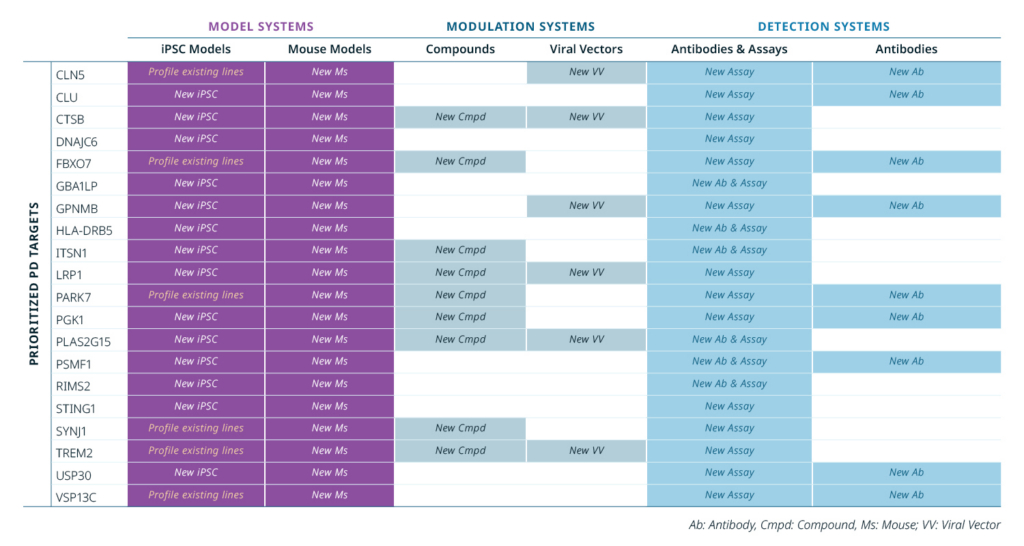
Table of Parkinson’s disease therapeutic targets identified by previous ASAP-funded research.
Our new CRN Tool Generation teams are developing next-generation tools — including CRISPR-engineered cell lines and mouse models, viral vectors, antibodies, and advanced chemical probes — specifically to reduce this friction. Once these resources are developed and validated, they will be made readily available to the global research community with no restrictions on their reuse and development. In doing so, we will ensure that all researchers can produce and reproduce consistent, reliable results regardless of their institution or geographic region.
From Breakthrough to Application
By creating these novel, sustainable, and field-enabling tools, we are focusing on the emerging targets identified through previous ASAP-funded research. These aren’t just “nice to have” resources; they are the essential reagents and models required to measure, visualize, and modulate therapeutic targets with unprecedented clarity, rapidly validate promising discoveries, and accelerate the transition from the laboratory bench to the patient’s bedside. Specifically, teams will:
- Generate new chemical compounds using structure-based design to precisely target the biological drivers of Parkinson’s.
- Develop the “delivery vehicles” needed to safely and effectively modulate gene expression and activity within the brain.
- Create validated antibodies designed to detect and measure the specific mitochondrial and oxidative stress targets that signal disease progression.
- Bridge the gap from laboratory innovation to clinical deployment by standardizing how we utilize and validate new biomarkers.
- Build and distribute stem cell models (iPSCs) that allow researchers to study emerging therapeutic targets in a human-relevant context.
Engineer sophisticated mouse models that carry human versions of Parkinson’s-related genes, ensuring research findings translate more accurately from mice studies to humans.
Together, this standardized toolkit of resources will help researchers worldwide turn discoveries into treatments. Explore all Tool Generation teams.
A Unified Commitment
With the addition of the Tool Generation teams, ASAP’s CRN has expanded to a total of 67 teams comprised of nearly 400 investigators across 24 countries.

Map showing the locations of Collaborative Research Network investigators.
Together, these teams are championing open science practices, making all their research outputs available for the research community to build upon. By providing these novel resources to the global community, we are ensuring that the most promising findings don’t just stay in a journal — they move into the treatment pipeline. Learn more about the CRN’s impact as a whole.


